Opposition to heritage-language education
If Canada is so well known for its support of multiculturalism, why are heritage-language programs so controversial?
The federal context for a new education policy in Ontario.
In 1977, Ontario launched the Heritage Language Program (HLP), offering 2.5 hours per week of instruction in languages other than English and French. The announcement came just a few years after the federal government introduced the Official Languages Act (1969) and its Multiculturalism Policy (1971). These federal policies set up a basic contradiction that we still live with today: we might all have access to our culture in Canada, but not necessarily our languages, since only English and French hold official status.
This contradiction had a direct impact on programs like the HLP. For many, the HLP symbolized hope, hope that schools could be more inclusive of the linguistic diversity that has long existed here.Â
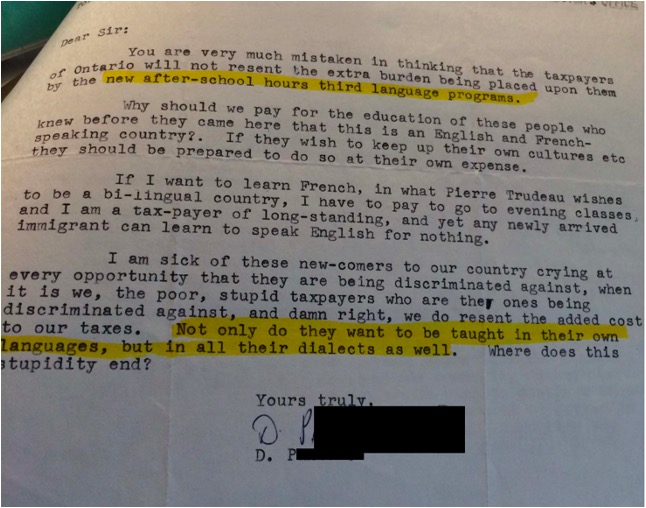
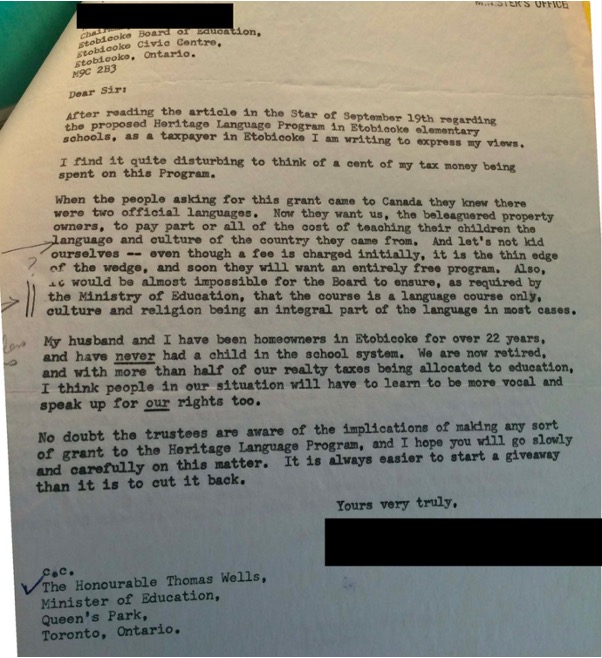
For others, the HLP was a threat to the principles of official bilingualism and multiculturalism. Within weeks of the programâs announcement, dozens of angry letters flooded into the Ministry of Education and local school boards, condemning the program as a dangerous misuse of tax monies and a threat to Canadian unity.
This story focuses on these angry letters, to help us understand the complex rationales some people used to protest the HLP and how those same rationales echo today.Â
Some letter authors used the status of Canada as an officially bilingual country to criticize the HLP.
Mrs. P. of Scarborough asked, âWhy should we pay for the education of these people who knew before they came here that this is an English and French-speaking country?â
Mrs. W. of Etobicoke complained to the chairman of her local school board, âWhen the people asking for this grant came to Canada, they knew there were two official languages. Now they want us, the beleaguered property owners, to pay part or all of the cost of teaching their language and culture of the country they came from.â
These arguments are instructive because they embraced official bilingualism as a weapon to protest other kinds of linguistic inclusion. Official bilingualism thus functioned as a shield to protect opponents of the HLP from claims they were simply prejudiced against non-English languages.
Using “race-neutral” categories to express radicalized opposition to the HLP.
Many letter writers based their opposition to the HLP on their status as taxpayers. This assumed that parents and others advocating for programs like the HLP were not and thus were making illegitimate claims to public money.
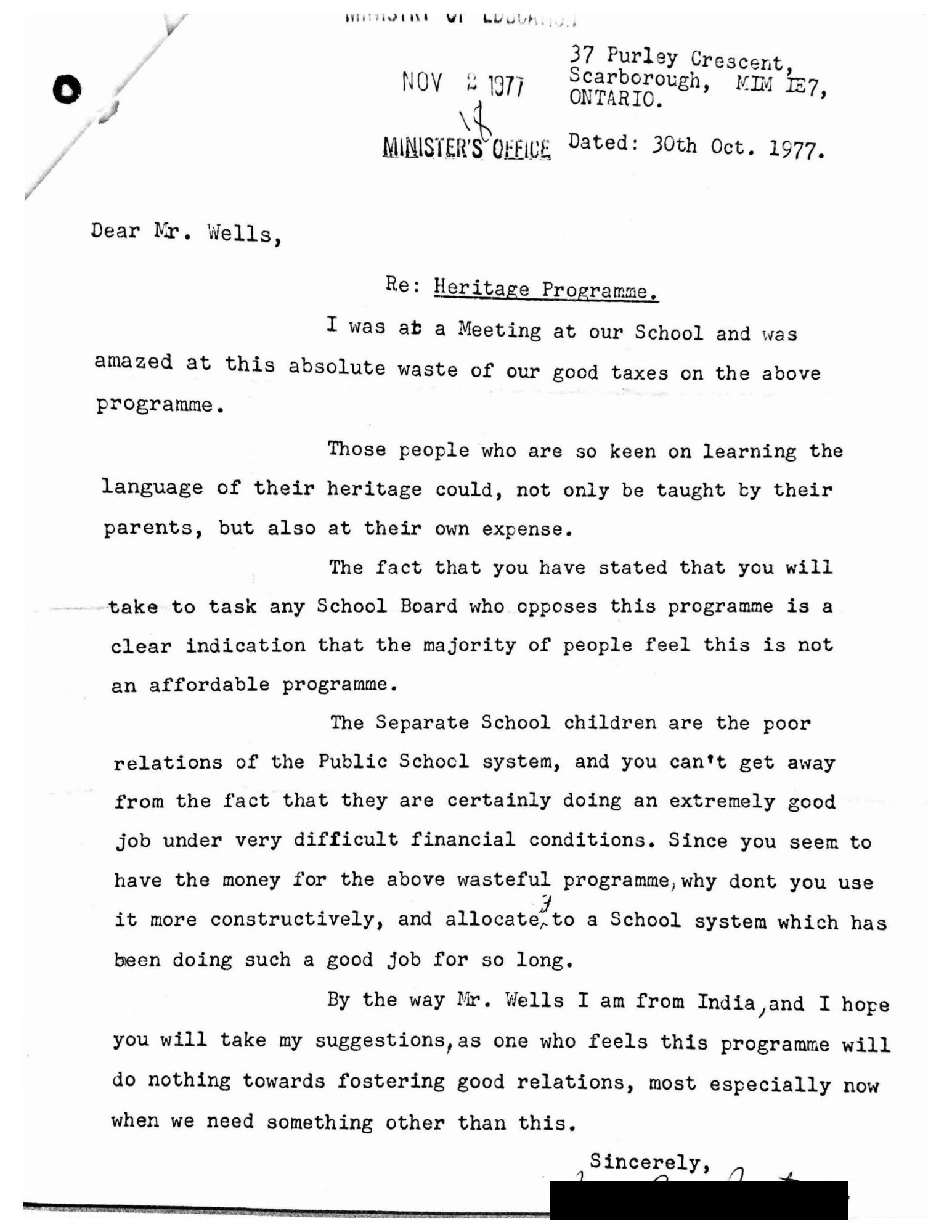
The letter below from Mrs. M is especially interesting, as she made sure to end the letter by saying she is from India. But her âamaze[ment] at this absolute waste of our good taxesâ on the HLP, and her description of âthose people who are so keen on learning the language of their heritageâ suggest her racial position as a white woman. In other words, equating âtaxpayerâ with âwhiteâ allowed (white) immigrants like Mrs. M. to oppose programs like the HLP.
Opponents turned the reality of social exclusion on its head.
Several letter writers argued that the HLP and similar programs would lead to greater social division in Canada.Â
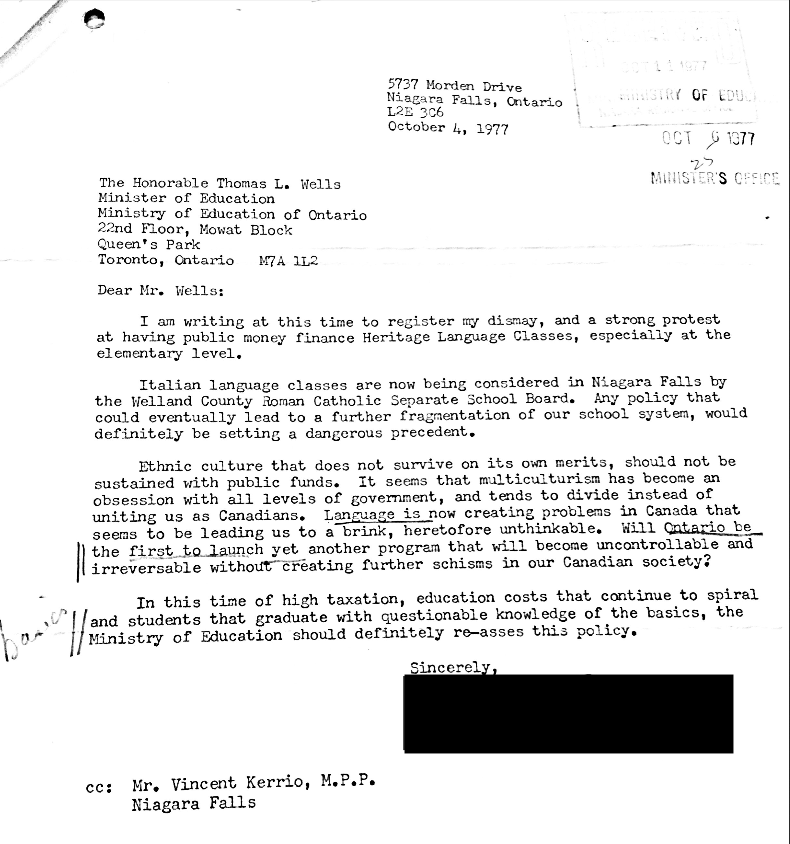
Mrs. N. of Niagara Falls raised this point quite sharply:
This argument turns the reality of social exclusion on its head. No longer is Anglo dominance, the common term at the time for what we might nowadays refer to as systemic racism and white-settler colonialism, the basis on which Canada was divided, with non-Anglo languages and cultures excluded from school. Now, it was efforts to be more inclusive of linguistic and racial diversity that would tear Canada apart.Â
These voices, preserved in the archives, reveal not only the anger against programs like the HLP but also the racialized hierarchies embedded in the very foundation of this language policy.
Much has changed in Canadian society since the HLP first appeared in 1977. But opposition to its successor today sounds remarkably the same.
More than four decades later, the International and Indigenous LanguagesâElementary Program (the current successor to the HLP) still exists.
But its structure remains nearly identical to when it began in 1977:
In this current context, when parents and other advocates call for change, to make Ontario schools more inclusive of linguistic and racial diversity, the opposition they receive sounds almost the same as the angry letters from 40+ years ago.Â
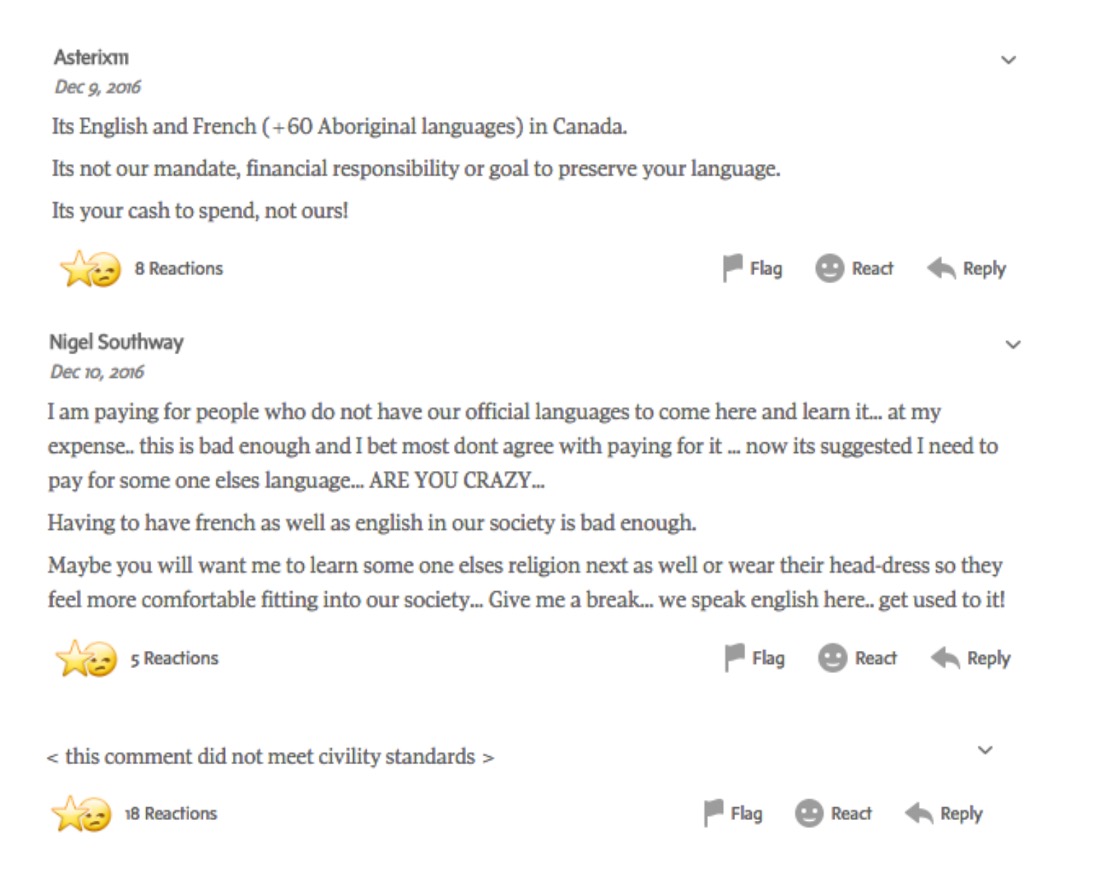
For example, in 2016, Yollanda Zhang wrote an opinion piece for the Globe & Mail newspaper, calling for immersion programs in languages other than French. The archived version of her commentary has since turned off the comments sectionâmaybe because the comments were so obnoxious and, in one case at least, âdid not meet the civility standardsâ set by the newspaper.Â
But the screenshot below captured some typical responses:
By tracing this history of opposition to programs like the HLP, we can see how structural inequities were constructedâand how they continue to shape the present.
Even as Ontarioâs population has become more diverse, the institutional message remains clear: English and French are necessary for participation in public life, while all other languages are an optional luxury.
This story of the HLP and its successor, the ILE program, is therefore not just about heritage language classesâit is about how policies of inclusion and exclusion are embedded in everyday schooling, and how the legacies of past decisions continue to shape opportunities for children and families today.