The Black Cultural Heritage and Heritage Language Programs
Are linguistic justice and racial justice compatible?
Imagine you lived in Toronto in the 1970s. So much change was underway, especially in Toronto schools.
Canada was just beginning to live out a new national identity as an officially bilingual country. And it was the first country in the world to adopt multiculturalism as official policy. Changes to immigration laws in the 1960s lifted racist quotas on who could come to Canada. As one example, immigration from the Caribbean more than doubled by the end of the 1960s1. Indigenous movements for self-determination were growing stronger, as well. A meeting of Black and Indigenous activists in Toronto in 1974 voiced a new political language of “Red Power”2 describe their resistance.
Schools reflected these changes – and became a place of protracted debate over who really belonged in Canada.
Many efforts to make Ontario schools more inclusive of racial and linguistic justice were the result of grassroots community organizing3.
But it wasn’t always clear whether everyone was fighting for the same thing.
Debates over heritage language programs quickly became a debate over race, equity, and educational power.
In June 1977, the Ministry of Education announced the Heritage Languages Program (HLP), set to begin that fall.
The program and the quick start were possible because many communities speaking minoritized languages had run private heritage-language programs for over a decade by this point.
Similarly, Black parents and activists had set up Black cultural heritage programs in community spaces as early as 1970. They designed these programs to challenge anti-Black racism that was pervasive in Ontario schools.
No sooner did the Ministry announce the HLP that Black parents and activists asked whether the HLP funding would also support Black cultural-heritage programs.
The Ministry said no.

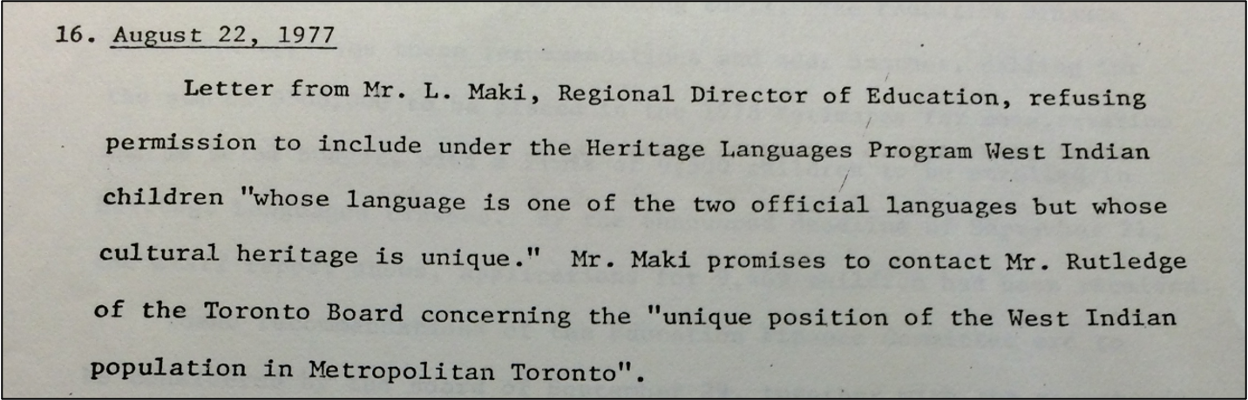
The Ministry’s refusal revealed its profound ignorance about the “unique position of the West Indian population in Metropolitan Toronto.”
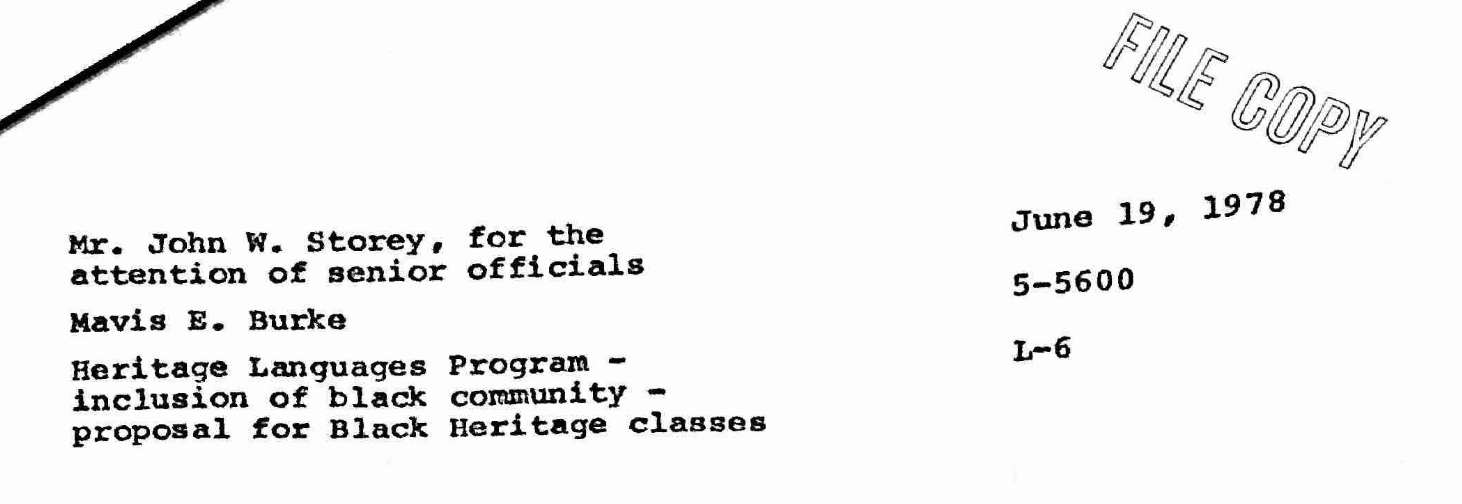
Dr. Mavis E. Burke, a prominent member of the Jamaican Canadian community who at that time served as an education officer for the Ministry of Education, summarized the conflict in a report to her supervisors in June 1978:
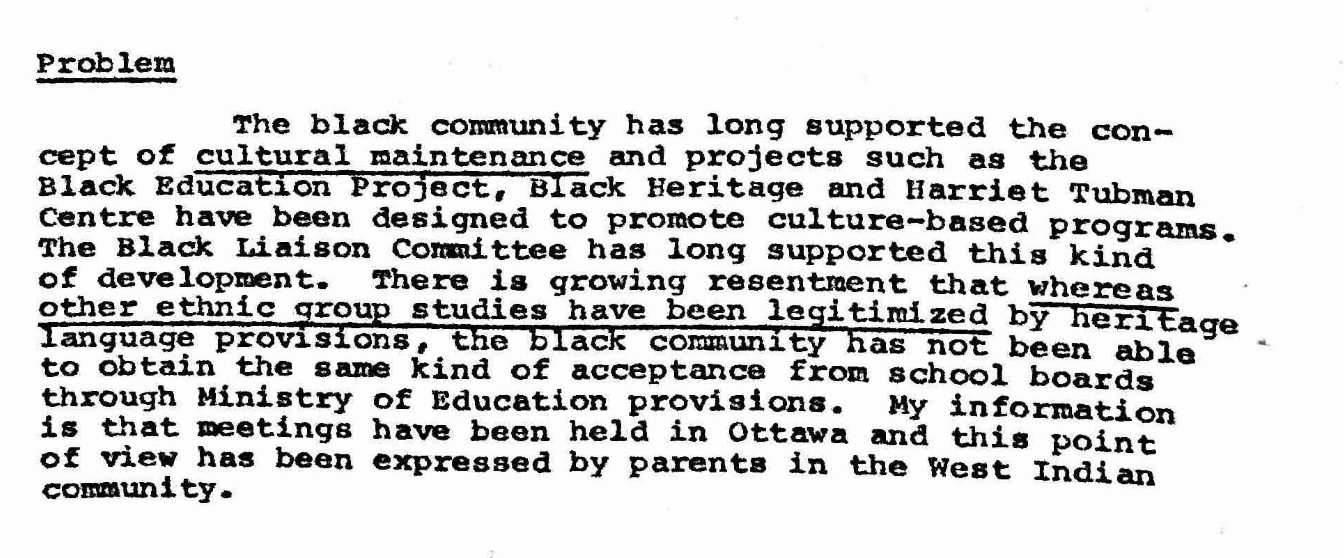
The Ministry’s exclusion of Black Cultural Heritage programs from provincial funding for heritage language education reflected and reinforced racialized divisions among immigrant communities in Toronto.
Its decision set up almost a decade of conflict over this fundamental question: Are linguistic justice and racial justice compatible?
Too often, advocates for heritage-language education were unable to really hear the important ideas that Black parents and community activists raised.
An important example is from a meeting that took place on June 24, 1981. The meeting was run by the Heritage Languages Advisory Committee for the Toronto Board of Education.
Keren Brathwaite represented the Organization of Parents of Black Children at the meeting. She began with a statement from the Organization’s perspective on the connection between linguistic and racial justice. Braithwaite’s comments focused on pervasive experiences of anti-Black racism that parents and students had been challenging for years.
(TDSB Archives, TDSB2003-0537, Notes from a meeting with the Organization of Black Parents, Appendix C Presentation of Organization of Parents of Black Children)
In the discussion that followed, heritage-language advocates failed to ask Braithwaite any questions about the comments she had just made.
Instead, they focused on the question of magnet schools to advance their cause of expanding linguistic justice in Toronto schools. They wanted to hear Braithwaite’s opinion about this proposal for magnet schools.
In fact, they asked multiple times about magnet schools, even though the responses from Brathwaite and other Black parents at the meeting were crystal clear.
(TDSB Archives, TDSB2003-0537, Notes from a meeting with the Organization of Black Parents)
Brathwaite and her colleagues argued that separate programs were tantamount to segregation. By contrast, their strategy for expanding racial justice focused on integrating the study of Black culture and history into the regular school curriculum, transforming it for all students.
Members of the Heritage Languages Advisory Committee and the Organization of Black Parents were clearly committed to making Toronto schools more racially and linguistically inclusive. But this meeting suggests heritage-languages advocates struggled to hear or fully understand the demands Black parents were making.
Scholars Roseann Liu and Savannah Shange have written about the kind of compatibility we address in this story as a question of thick solidarity:
“a kind of solidarity that mobilizes empathy in ways that do not gloss over difference, but rather pushes into the specificity, irreducibility, and incommensurability of racialized experiences.”
— Liu & Shange
Learning from Liu and Shange, we argue that making demands for linguistic and racial justice compatible doesn’t mean we all have to make the same demands.
However, as we advocate for greater linguistic justice in our schools, we need the humility and political clarity to consider how linguistic demands may actually exacerbate racial injustice. In this case, the demands of some heritage-language advocates for magnet schools were understood by some Black parents as a form of segregation. But heritage-language advocates couldn’t always hear or understand that response.
Similarly, as we advocate for greater racial justice in our schools, we need also to consider the linguistic dimensions of racism. How can we formulate demands for racial justice to ensure they advance linguistic justice as well?
To learn more about thick solidarity and how we can ensure linguistic and racial justice are compatible goals, we invite you to review Resources for Change for more ideas on ensuring linguistic and racial justice are compatible goals.
For more information on the stories shared here, we invite you visit the Publications page of this website, where you will find links to two articles (Aladejebi & Bale 2025; Bale & Kawaguchi 2020) related to this story.
For more information on thick solidarity, we invite you read Roseann Liu and Savannah Shange, “Toward Thick Solidarity: Theorizing Empathy in Social Justice Movements,” Radical History Review 131 (May 2018), 189-198.